
OneClick Travel Tech is a leading travel technology company specializing in custom travel booking solutions, offering services like B2B and B2C travel portal development, white label solutions and mobile app development to enhance customer experiences.
© ONECLICK TRAVEL TECH. ALL RIGHTS RESERVED.


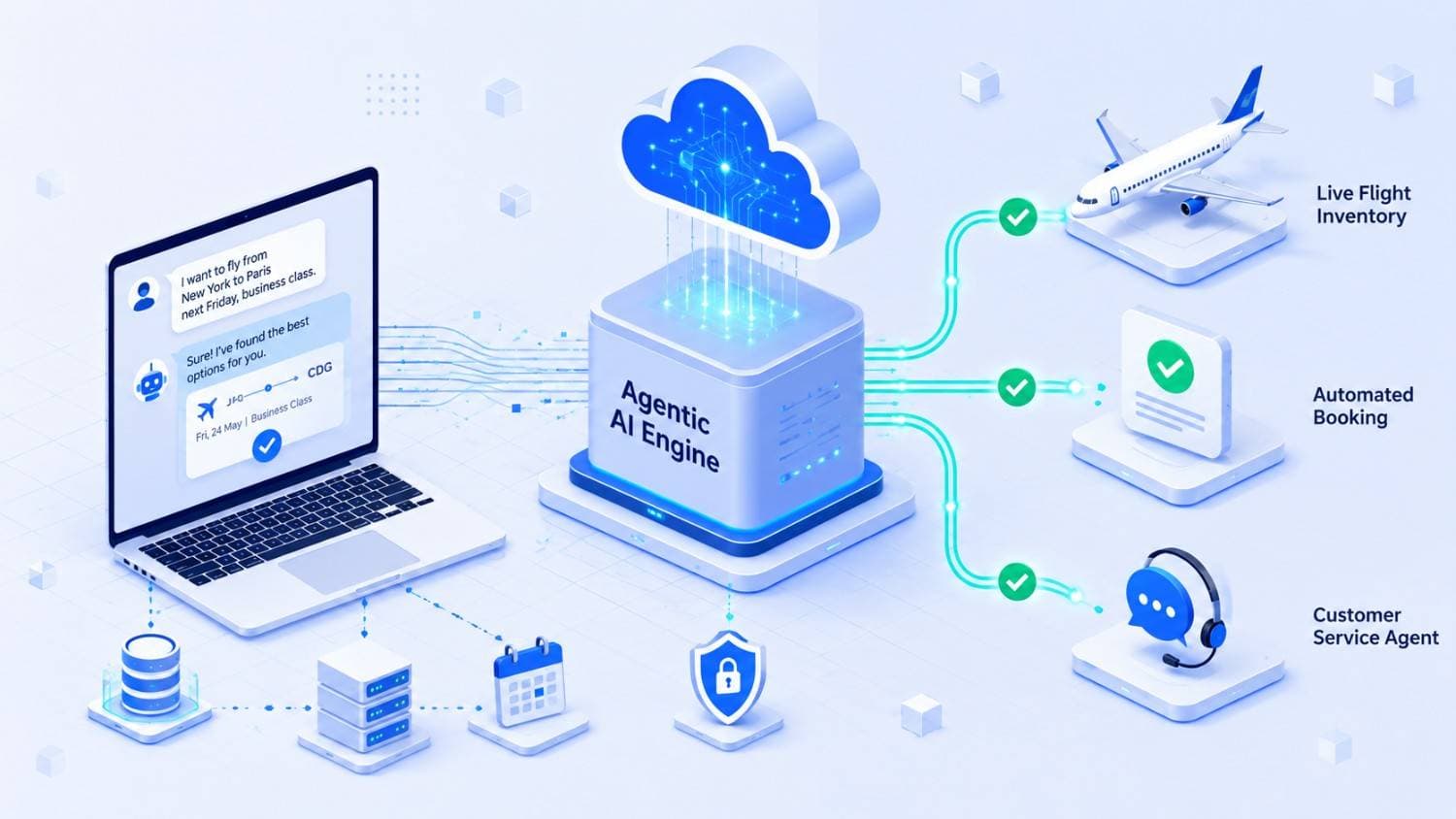
Agentic AI in travel refers to AI systems that don't just answer questions, they act. In 2026, airlines are using it to search inventory, book flights, and handle rebooking's on a traveler's behalf, with little to no human involved at each step.
Airlines have talked about AI for a decade. What changed in 2026 is that AI stopped recommending and started acting. A traveler can now describe a trip in plain language and have an AI agent search inventory, compare fares, complete the booking, and handle a rebooking if the flight gets cancelled, without a human touching any of those steps. That shift, from AI that answers questions to AI that completes transactions, is what the industry means by agentic AI, and it is reshaping how airlines build booking systems, customer service, and pricing models this year.
IDC's Future Scape research puts a number on where this is heading: by 2030, 30 percent of travel bookings are projected to be executed directly by AI agents, not by a human clicking through a website. That is not a distant forecast. Airlines, GDS providers, and travel technology companies are already building toward it in 2026.
This guide breaks down what agentic AI actually means, how it differs from the chatbots most travel businesses already use, which airlines are deploying it right now, and what travel agencies and OTAs should actually do about it this year, drawing on the same AI-driven travel solutions work we do for travel technology clients evaluating this shift.
Agentic AI refers to AI systems that complete multi-step tasks on a traveler's behalf, rather than simply answering questions or presenting options. In a booking context, this means an AI agent can search live inventory across airlines, weigh a traveler's preferences and loyalty status, apply payment, and confirm a reservation within a single conversation.
The distinction that matters here is autonomy. A standard travel chatbot retrieves information. An agentic system plans a sequence of actions, executes them, and only checks in with a human when a decision requires it. That is a fundamentally different piece of software, even if both are labeled "AI" in a vendor's marketing
Travel businesses evaluating this technology usually want a straight answer to one question: is this the same thing we already have, or is it genuinely different?
Traditional travel chatbots are built to retrieve and present information. Ask one about flight options to Chicago, and it can tell you a 6pm departure exists, quote a fare, and link to a booking page. It answers within a defined script or a retrieval system, and a human still completes the transaction.
An agentic system goes several steps further. It checks real-time inventory across sources, applies the traveler's stated preferences and budget, completes the booking, processes payment, and sends a confirmation, all inside the same conversation. If a flight later gets cancelled, the same system can identify the disruption, propose a new option, and rebook automatically.
Takeaway: if the system stops at giving you options, it is a chatbot. If it completes the transaction and can act again later without a new prompt, it is agentic.
A June 2026 report from Amadeus and Microsoft frames this year as the point where airlines move from pilot projects into production systems. Julie Shainock, Microsoft's Global Managing Director for Travel, Transport and Logistics, described 2026 as a defining year for agentic AI in aviation, with most airlines expected to move from exploration to real-world deployment over the following 18 months.
The Amadeus report, built on interviews with airlines including Azul Linhas Aéreas, Icelandair, and Southwest Airlines, identified five specific areas where agentic AI is already generating measurable value: automated voice rebooking (the same category of technology behind voice-activated travel booking systems travel agencies are starting to adopt), agentic commerce, intelligent digital marketing, turnaround management, and personalized offers. That is a notably narrow, practical list compared to the broad "AI will change everything" framing common a year earlier, and it signals the industry has moved past the demo stage.
In February 2026, Sabre, PayPal, and MindTrip announced what they describe as the travel industry's first end-to-end agentic AI booking system. A traveler describes a trip in natural language through MindTrip's conversational interface, MindTrip queries Sabre's Mosaic APIs for real-time access to more than 420 airlines and two million hotel properties, and PayPal's agentic commerce infrastructure completes payment within the same conversation, according to OAG's March 2026 airline tech radar. The system is scheduled to launch in the second quarter of 2026, and it is not a prototype, Sabre has committed its full Mosaic content library to the partnership.
This kind of conversational, transaction-complete booking flow is the same underlying pattern behind newer conversational booking channels, including WhatsApp-based flight and hotel booking engines already in production for travel agencies today, and automated email booking flows that handle confirmations and itinerary changes without an agent manually replying to every message.
Malaysia Airlines launched an AI customer service agent called Mavis in February 2026, built on Ada's Agentic Customer Experience platform and running 24/7 across the airline's website, app, and email in English and Malay. The distinction that matters is that Mavis integrates directly with the airline's operational systems to check real bookings, confirm gate numbers, and assist with check-in, rather than quoting a static FAQ page and routing the traveler to a human.
United Airlines has taken a related but different approach, using predictive analytics to identify likely disruptions from weather and air traffic data before they generate a wave of support calls, then triggering proactive rebooking and passenger communication ahead of time. Both approaches point to the same underlying requirement: customer support infrastructure built for flight booking engines that can plug into real operational data, not a chatbot sitting on top of a static FAQ.
Agentic AI is also changing how airlines build offers, enabling real-time price adjustments, ancillary bundles tailored to specific customer segments, and automated rebooking and compensation during disruptions, largely without a human approving each individual decision.
Airlines including Icelandair and Southwest are testing AI agents that monitor maintenance schedules, crew availability, and refueling simultaneously to recommend integrated turnaround plans, extending agentic AI from the booking experience into aircraft operations.
None of the systems above work without trust in the underlying data, and that is where most of the real risk sits, not in the AI model itself. Building an airline AI agent is, in practice, an identity project, an API project, a data governance project, and a change management project all at once. If those foundations are weak, the agent becomes another fragile integration rather than a reliable one, regardless of how capable the underlying model is.
Passengers need clarity on when they are dealing with an AI agent, what it is authorized to decide without a human, and what recourse exists if it makes a mistake, particularly around payment and compensation decisions. Airlines and travel businesses building on this technology need audit trails for exactly the same reasons. This is not a reason to avoid agentic AI, but it is the reason staged deployment, starting with lower-stakes decisions and expanding as trust is established, has become the standard approach across the airlines cited in the Amadeus report.
The honest answer depends on what problem you are actually trying to solve, not on matching a competitor's announcement.
Start now if: your business already has a real customer service bottleneck (high call volume, slow rebooking response times) or a clear conversion problem in your booking flow. Agentic AI delivers the clearest return where it replaces a specific, measurable manual process, voice rebooking and automated customer resolution being the two areas the Amadeus research found generate value fastest.
Wait and build foundations first if: your booking data is fragmented across systems, your GDS or NDC integration is inconsistent, or you do not yet have reliable real-time inventory access. Agentic AI amplifies whatever data foundation it is built on. A system layered onto fragmented data produces fragmented, unreliable decisions faster than a human would have made them.
For most small to mid-sized travel agencies and OTAs, the practical starting point is not building a full agentic booking assistant from scratch. It is ensuring the underlying booking infrastructure, GDS access, real-time inventory, and automated confirmation flows, is solid enough to support agentic features when you are ready to add them. Our sister platform Travel Terminus has broken down how AI-driven deployment models fit alongside traditional Amadeus GDS booking systems for agencies weighing exactly this decision. That foundation is the difference between an agentic layer that works reliably and one that fails at the exact moments customers need it most.
Agentic AI in travel refers to AI systems that complete booking, service, or operational tasks autonomously, such as searching inventory, applying preferences, and completing payment, rather than simply presenting information for a human to act on.
Airlines are using agentic AI for end-to-end conversational booking (Sabre, PayPal, MindTrip), autonomous customer service (Malaysia Airlines' Mavis), predictive disruption management (United Airlines), personalized pricing, and aircraft turnaround planning (Icelandair, Southwest).
Agentic AI systems in production today, including the Sabre-PayPal-MindTrip pipeline, typically include a confirmation step before finalizing a purchase. Safety and reliability depend heavily on the airline or platform's underlying data governance and audit trail infrastructure, not on the AI model alone.
Current deployments focus on automating specific, repeatable tasks such as rebooking and basic customer service inquiries, not on replacing the judgment-based advisory work travel agents provide for complex itineraries, group travel, or corporate accounts.
Malaysia Airlines, United Airlines, Icelandair, Southwest Airlines, and Azul Linhas Aéreas are among the airlines with named, in-production agentic AI deployments as of mid-2026, according to Amadeus and OAG reporting.
Standard AI in travel typically retrieves or recommends information, such as a chatbot listing flight options. Agentic AI completes the full task autonomously, searching, deciding, booking, and paying, within defined boundaries and with human oversight available where needed.
Agentic AI in travel is not a rebrand of the chatbot. It is a genuine shift toward systems that plan, decide, and act across booking, service, and operations, often connecting previously separate systems into one continuous flow. 2026 is the year this technology moved from conference-stage demos into systems real travelers depend on. The businesses that get the most value from it will be the ones that treat data infrastructure and governance as the real starting point, not the AI model itself.
If you already know the specific feature you want built on top of your booking platform, you can hire a travel technology developer directly to scope it out.
Sources: Amadeus and Microsoft, "Airlines in the Agentic Age," June 2026; OAG, "March 2026: The Month Agentic Travel Gets Real"; IDC FutureScape, Worldwide Hospitality, Dining, and Travel 2026 Predictions.