
OneClick Travel Tech is a leading travel technology company specializing in custom travel booking solutions, offering services like B2B and B2C travel portal development, white label solutions and mobile app development to enhance customer experiences.
© ONECLICK TRAVEL TECH. ALL RIGHTS RESERVED.


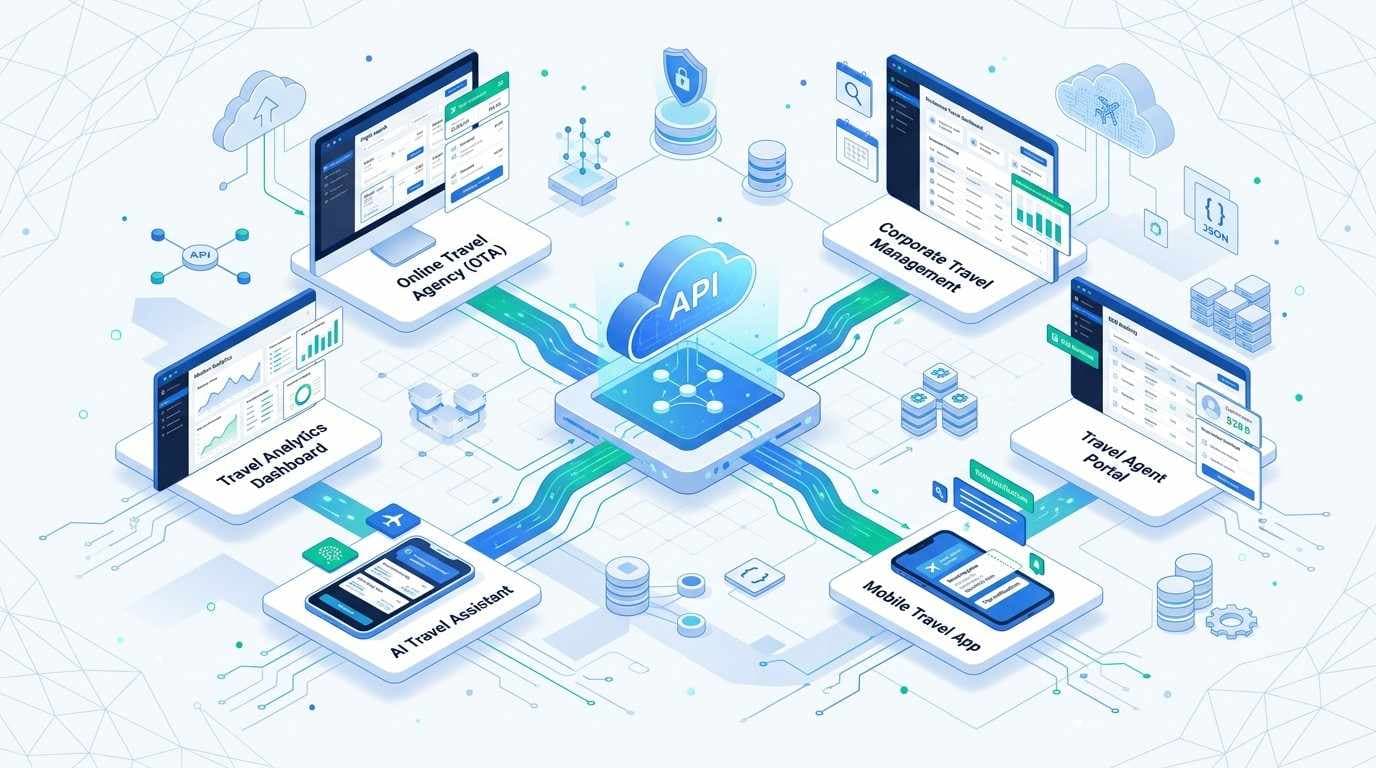
The Amadeus flight API supports far more than basic flight search, and most travel businesses only use a fraction of what it can actually do.
Amadeus, the largest Global Distribution System by transaction volume, offers a flight API catalog that covers far more ground than a simple search box. In one project we're familiar with, a B2B OTA layered an AI interface on top of its existing Amadeus Enterprise setup and cut average booking time from 9.2 minutes to 91 seconds, without touching the underlying certified GDS integration at all. That result illustrates the real point of this article: the Amadeus travel API suite is a toolkit, and most of its value shows up in how creatively a business applies it, not in the base search call alone.
Beyond Flight Offers Search, the catalog includes fare pricing, booking creation, ancillary services, delay and choice prediction, and destination inspiration tools. Each of these supports a different use case, and travel businesses that only integrate the search function are leaving real capability, and often real revenue, on the table.
This is the foundational use case and the one most platforms build first. A Amadeus API integration for search means calling Flight Offers Search with an origin, destination, and travel dates, then returning available flights with live pricing, baggage details, and fare rules attached. For an OTA or travel agency, this is the difference between showing customers accurate, bookable fares and showing stale or cached data that falls apart at checkout.
The practical challenge here isn't the call itself, it's what happens around it. Fares and availability shift constantly, so any platform built on this use case needs a price re-validation step through Flight Offers Price before a customer commits to booking, otherwise the search results become a liability rather than a feature.
Corporate travel introduces a use case that public facing OTAs rarely need: policy compliance. Corporate accounts negotiate specific fare rules, carrier restrictions, and cabin class limits, and every search result needs to be checked against those rules before an agent presents options. Done manually, this is slow and error prone. In the case referenced above, manual policy cross-referencing was consuming one to two minutes per booking and contributing to a compliance rate around 81 percent before automation.
Building a policy aware ranking layer on top of this data means passing raw search results through a rules engine that surfaces compliant fares first and flags exceptions for manual override, rather than hiding them outright. This use case matters most for travel management companies and B2B agencies serving corporate accounts with negotiated rates, less so for consumer facing leisure platforms.
Agents type structured commands or fill in form fields to run a search, then manually interpret results against whatever the traveler actually asked for. This works, but it requires trained staff and takes real time per booking, particularly for complex multi-leg itineraries.
An intent parsing layer, typically a fine-tuned language model, converts a plain language request directly into the structured parameters the Amadeus flight search API needs. Agents describe what the traveler wants instead of building the query themselves, and the system asks a clarifying question when the request is ambiguous rather than failing silently.
One line takeaway: the traditional interface asks agents to learn the system, the AI layer asks the system to understand the agent, and for high volume booking desks the second approach compounds into real time savings across thousands of monthly transactions.
Seat selection, meal preferences, and baggage add-ons represent a use case that's frequently bolted onto the end of a booking flow rather than built into it, which is exactly why attach rates tend to underperform. A flight search API integration solution that pulls ancillary options, through the Seat Maps API and related services in the broader Amadeus API suite, directly into the confirmation step rather than a separate post-booking screen tends to see meaningfully higher attach rates, since the traveler is already in a buying mindset at that point in the flow.
This use case matters commercially because ancillary revenue is close to pure margin compared to base fare revenue. A platform that treats ancillaries as an afterthought is generally leaving a measurable percentage of available revenue unclaimed on every booking.
Every use case above depends on the same underlying reliability requirement: the data has to be live, and the booking flow has to re-validate pricing before finalizing a reservation. Skipping that re-validation step to save latency is the most common technical mistake we see across these projects, and it causes the same problem regardless of which use case sits on top, a customer sees a price that's no longer honored.
There's also a scoping risk specific to more advanced use cases like AI powered search or ancillary automation. These projects layer new functionality on top of an existing, working Amadeus travel API integration, and the biggest risk isn't the AI or automation layer itself, it's accidentally disrupting the certified GDS connection underneath it during development. As a flight booking technology provider that has built these layered projects without touching the underlying certified integration, our parent company, OneClick IT Solution, treats the existing Amadeus setup as untouchable infrastructure and builds new capability as a separate service tier around it, rather than modifying the certified connection directly.
Our Amadeus AI layer booking speed case study documents this directly. A mid-size B2B OTA serving corporate accounts across Europe and the Middle East had a mature, fully certified Amadeus Enterprise setup, a 240-agent booking desk, and 4,000 to 6,000 monthly bookings, but average booking time sat between 9 and 11 minutes because agents were working through traditional GDS query interfaces manually.
OneClick built a natural language intent engine on top of the existing Amadeus API connection, added a policy aware fare ranking layer, introduced session context so multi-leg itineraries didn't require restarting the search, and moved ancillary selection into the booking confirmation step. The case study reports average booking time falling from 9.2 minutes to 91 seconds, policy compliance improving from roughly 81 percent to 96.4 percent, ancillary attach rate rising from 34 percent to 61 percent, and the same 240-agent team processing 31 percent more bookings within six months, all without modifying the underlying certified GDS integration.
Start with real time fare search if:
Prioritize policy aware ranking or AI powered search if:
Prioritize ancillary integration if:
For a broader look at how these pieces fit together in a full booking engine, our flight API blog covers related integration topics in more depth.
The core use cases include real time fare search, price and booking confirmation, policy aware ranking for corporate travel, AI powered natural language search interfaces, and ancillary service attachments like seat and baggage selection at the point of booking.
Yes. An AI layer typically sits on top of an existing Amadeus API integration, converting natural language requests into structured search parameters and ranking results, without requiring changes to the certified GDS connection underneath it.
Not on its own. The API returns fare and availability data, and a separate policy ranking layer built by the integrating business applies corporate rules to that data before presenting options to a travel agent or booker.
Through endpoints like the Seat Maps API and related ancillary services, which let a platform surface seat, meal, and baggage options directly within the booking confirmation flow rather than as a separate post-booking step, typically improving attach rates.
It doesn't have to be. Built correctly, an AI or automation layer sits as a separate service tier that reads from and writes to the existing Amadeus connection, leaving the certified integration and settlement processes untouched.
It depends on current bottlenecks, but for established platforms with a staffed booking desk, reducing manual search and policy checking time tends to show measurable results fastest, since it directly reduces labor time per transaction at existing booking volume.