
OneClick Travel Tech is a leading travel technology company specializing in custom travel booking solutions, offering services like B2B and B2C travel portal development, white label solutions and mobile app development to enhance customer experiences.
© ONECLICK TRAVEL TECH. ALL RIGHTS RESERVED.


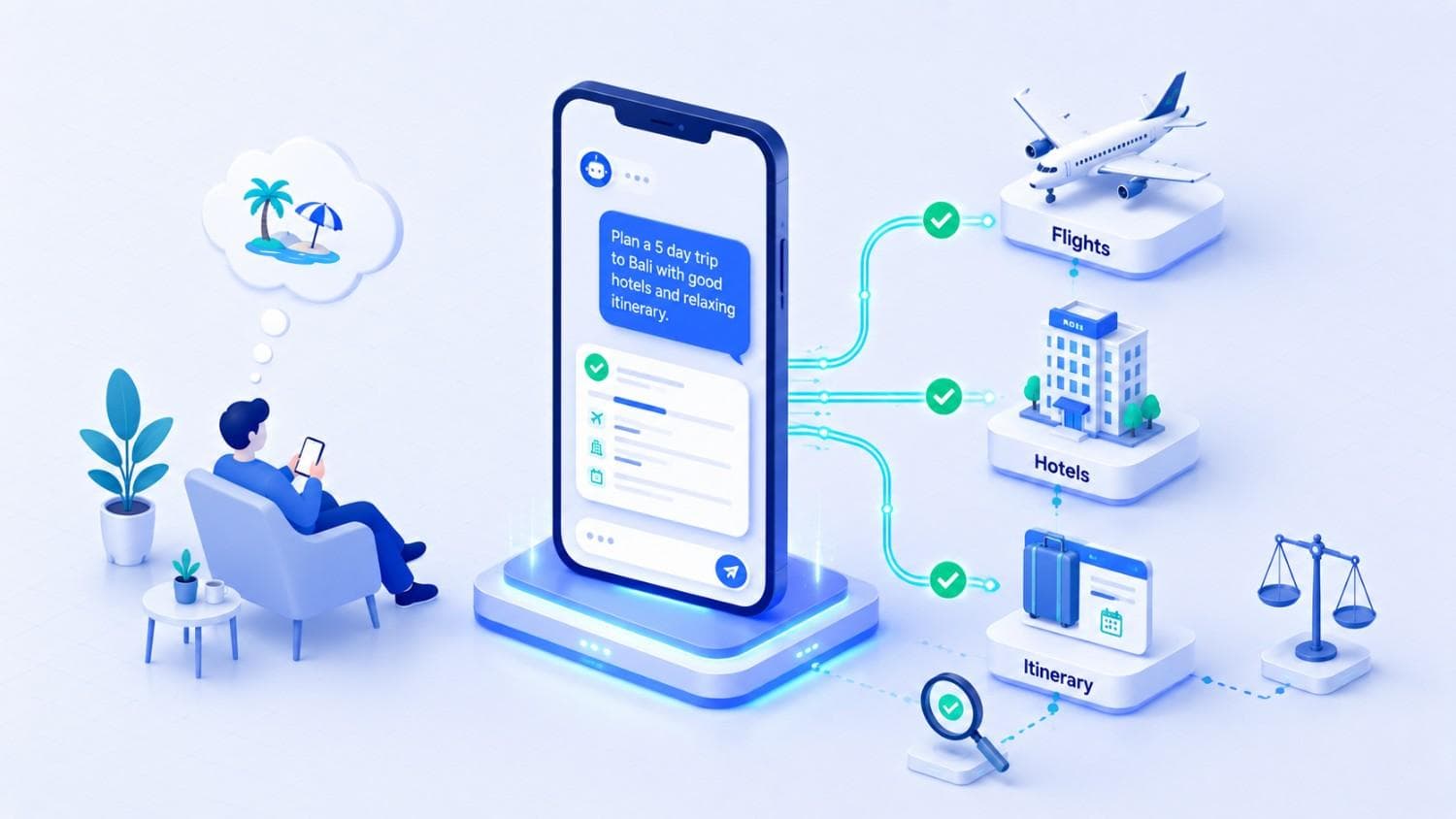
Ninety percent of travelers know AI can help plan a trip, but only 38 percent have tried it. Among those who have, 78 percent say they booked based mainly on an AI recommendation. This guide covers how AI travel agents actually work, the tools driving the shift, and the accuracy risks most coverage leaves out.
Ninety percent of travelers now know AI can help plan or book a trip. Only 38 percent have actually tried it. But among the people who have, the shift is not subtle: 78 percent say they have booked travel based primarily on an AI recommendation. That gap between awareness and use is where the real story sits in 2026, most people know this exists, a smaller group has crossed over, and the ones who have are already handing over real decisions, not just browsing suggestions.
This is the consumer-facing half of a shift we've also covered from the airline side, how agentic AI is already changing airline operations, booking, customer service, and pricing. This guide covers how AI travel agents actually work, which tools are driving the shift right now, what the adoption numbers say, and the risk side that most coverage of this topic skips entirely.
An AI travel agent is a system that interprets a plain language request, gathers options from connected data sources, and returns a tailored itinerary or booking, rather than a list of links a traveler has to sort through manually. Ask a traditional search engine for "best family hotel in Lisbon" and it returns results to filter through. Ask an AI travel agent the same question and it interprets intent, asks clarifying questions about budget and preferences, and synthesizes a plan tailored to the traveler, sometimes carrying that plan all the way into an actual booking.
The behavioral shift is significant precisely because of that structural change: instead of Search → Open Tabs → Compare Manually → Restart Search, the flow becomes Ask → Refine → Compare → Book, all inside a single conversation. This same conversational pattern is already live in production for travel businesses today, WhatsApp-based flight and hotel booking works on the identical underlying principle, a traveler describes what they want in natural language, and the system handles search, comparison, and booking within that same conversation.
The shift is not theoretical, specific tools are already live and integrated into how people search and book.
Google rolled out an AI-powered itinerary builder called Canvas inside its AI Mode Labs experiment, combining live data from Google Flights, Google Maps, and web sources to suggest hotels, restaurants, and activities, alongside an AI-driven Flight Deals tool that has expanded to more than 200 countries. ChatGPT has integrated major travel and service apps directly, including Booking.com, Expedia, and Uber, letting a conversation move from planning straight into a booking flow without switching platforms.
Expedia built its own conversational assistant, Romie, and is embedding its content across partner AI systems including OpenAI's Microapps and Operator and Microsoft Copilot Actions, so a prompt like "show me weekend options in Santa Fe" can move to a full itinerary and booking in minutes. This is the same category of AI-driven travel solutions travel businesses are now building for their own booking platforms, not just something happening inside the big consumer brands. Kayak is building AI agent software to plan, book, and manage trips in real time, with the company framing it as travelers either using a Kayak AI agent directly or relying on assistants powered by Kayak's underlying data. On the corporate side, Navan focuses specifically on actually booking and servicing real business trips rather than generating conversational travel advice.
The behavioral data backs up what these product launches suggest. Beyond the 78 percent of AI users who have booked based primarily on an AI recommendation, 78 percent of travelers say it matters that hotels appear in AI-generated recommendations, and 84 percent say a trusted AI recommendation makes them more likely to book a specific property. That second number matters as much as the booking behavior itself, it means visibility inside AI systems is becoming as important as ranking in search results or on an OTA.
McKinsey's own research points to a similar early-stage pattern industry-wide: about 80 percent of travel companies are actively using AI in some form, but only 20 percent report seeing direct impact on their bottom line yet, a gap McKinsey's Jules Seeley describes as reflecting how early this adoption phase still is. The current phase blends AI-generated planning with traditional booking platforms and human oversight, while the next phase, projected around 2027, is fully agentic AI travel execution, systems capable of comparing inventory, holding reservations, and coordinating changes without manual intervention.
This is the part most coverage of AI travel agents leaves out, and it matters as much as the adoption story.
A comprehensive analysis of automated itineraries found nine out of ten AI-generated itineraries include at least one major factual error, ranging from impossible travel logistics to entirely invented landmarks. Separately, a Squaremouth survey found 47 percent of travelers have used AI to build an itinerary, and of that group, one-third reported receiving false or misleading information. A peer-reviewed 2026 study in the Journal of Consumer Behaviour analyzed how hallucinations in ChatGPT-generated itineraries affect traveler behavior across two studies with over 1,000 participants, and found that hallucinations significantly reduce how accurate and trustworthy travelers perceive the plan to be, meaning the damage isn't limited to the specific wrong detail, it undermines confidence in the whole itinerary.
There is a more extreme version of this risk worth knowing about too. The FBI has issued warnings about AI-generated fake destination imagery and fake booking sites targeting travelers, including a documented case of a couple driving more than 230 miles to a tourist attraction that turned out to only exist as an AI-generated video.
None of this means AI travel planning should be avoided. It means the output needs to be treated the way a careful traveler already treats any single source, useful, but worth checking against something else before money changes hands.
This is a question McKinsey raises that consumer travel coverage rarely addresses directly, and it is genuinely worth knowing. When an AI assistant researches and books a trip, it is not always transparent whether the booking runs through the airline's own site, the hotel's website, or an intermediary like an online travel agency, and that ambiguity creates real questions about who is actually the merchant of record, how currency and exchange rates are handled, and whether a traveler's money is held securely if the trip turns out to be refundable. These are not edge cases, they are the kind of practical detail that only becomes visible when something goes wrong, a cancellation, a dispute, a refund that gets stuck.
For travelers, the practical takeaway is simple: before confirming any AI-assisted booking, it is worth knowing exactly which company is actually processing the payment and holding the reservation, not just which AI assistant suggested it.
This consumer-facing shift does not exist in isolation. It sits on top of the same underlying agentic AI trend covered above, and the traveler-facing AI assistants driving it, Google Canvas, ChatGPT, Expedia Romie, Kayak, are increasingly the front door into the same airline-side booking infrastructure. A traveler chatting with an AI assistant to book a flight is, more often than not, ultimately routed into the same systems and booking infrastructure that airlines and travel businesses are building on the other end.
For travelers, the practical advice that keeps showing up across research is consistent: use AI to do the heavy lifting of structuring a trip, then verify the details that actually matter before booking, visa requirements, passport validity, timed-entry tickets, and transportation schedules against official sources, since AI systems routinely underestimate costs and occasionally invent specifics with high confidence.
For travel businesses, the practical implication is different but connected. As AI recommendation visibility becomes as important as search ranking, and as voice-activated booking systems and conversational assistants become a real front door for bookings, the businesses that adapt their booking infrastructure to be legible and accurate to AI systems, not just to human searchers, will be positioned better than the ones that treat this as a passing trend.
An AI travel agent is a software system that interprets a traveler's request in natural language, gathers options from connected data sources like flight and hotel inventory, and returns a tailored itinerary or completed booking, rather than a list of results to sort through manually.
Research has found that nine out of ten AI-generated itineraries contain at least one major factual error, and one-third of travelers who used AI to build an itinerary reported receiving false or misleading information, according to a Squaremouth survey.
Some tools, including Expedia's Romie and Kayak's AI agent, can move from planning into an actual booking within the same conversation today. Fully autonomous, end-to-end agentic AI travel execution, without any human confirmation step, is projected to become mainstream around 2027.
It can be, but travelers should confirm exactly which company is processing payment and holding the reservation, since AI-assisted bookings are not always transparent about whether they route through an airline, hotel, or intermediary, which affects refund and dispute protections.
Google's AI Mode with Canvas, ChatGPT with its Booking.com, Expedia, and Uber integrations, Expedia's Romie assistant, and Kayak's AI agent are among the most widely used tools currently capable of moving from planning into booking.
Current data suggests AI is changing how people research and book routine trips, but complex itineraries, group travel, and situations requiring judgment still commonly involve human travel agents or at least human verification of AI-generated plans.
AI travel agents have moved past the demo stage. Real tools, real integrations, and real booking behavior all point to a genuine shift in how people plan and book trips, not just a trend being talked about. But the accuracy data is just as real, and just as important, nine out of ten AI-generated itineraries contain a factual error, and the businesses and travelers who treat AI output as a starting point rather than a finished plan are the ones who will actually benefit from this shift rather than get burned by it.
If you are building or upgrading booking infrastructure to work well with how travelers are now searching and booking through AI, you can hire a travel technology developer to scope what that would take for your platform.
Sources: McKinsey, "How Agentic AI Could Transform Travel," December 2025; TakeUp AI, "The Rise of AI-Planned Travel in 2026"; Squaremouth survey via Elliott Report, January 2026.