
OneClick Travel Tech is a leading travel technology company specializing in custom travel booking solutions, offering services like B2B and B2C travel portal development, white label solutions and mobile app development to enhance customer experiences.
© ONECLICK TRAVEL TECH. ALL RIGHTS RESERVED.


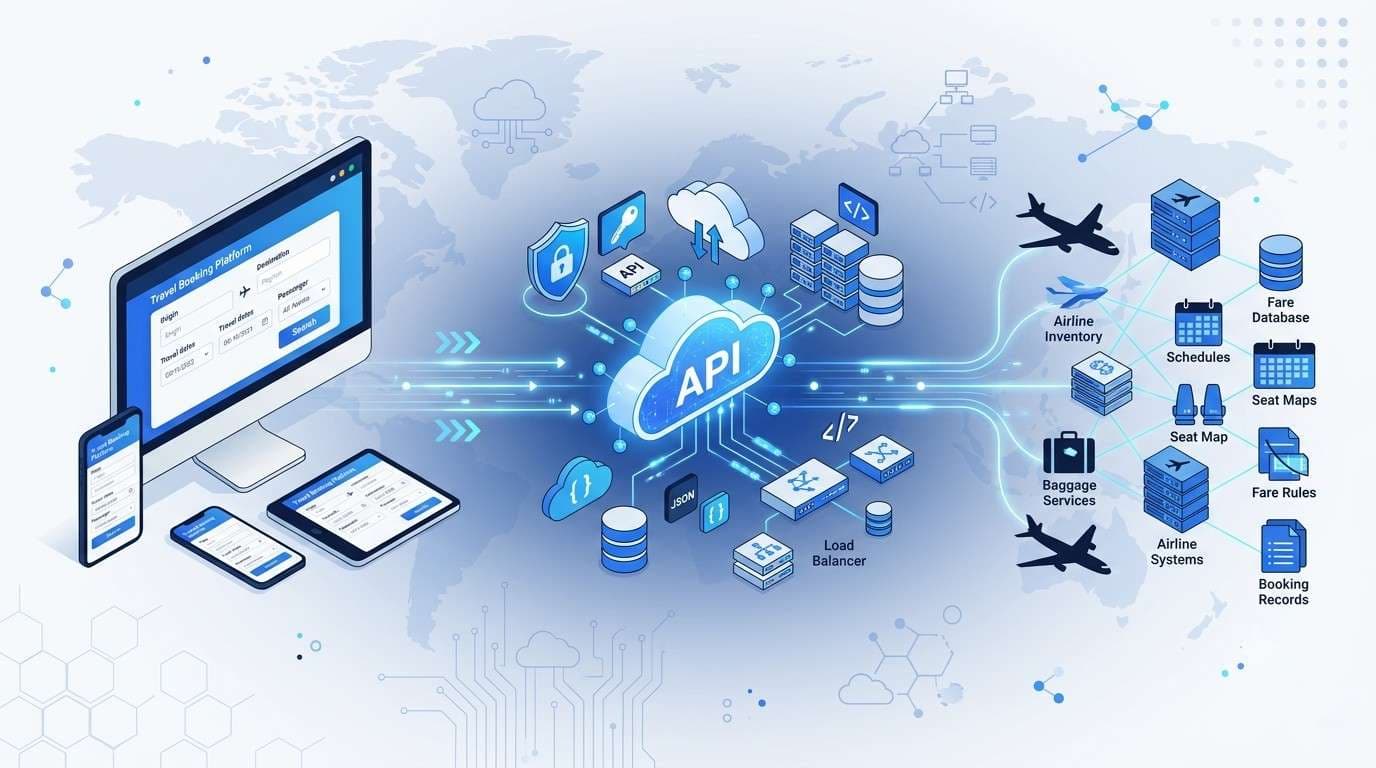
Integrating the Amadeus flight search API involves more moving pieces than calling one endpoint, and getting the sequence wrong is the most common reason booking platforms launch with unreliable pricing.
Amadeus, the largest Global Distribution System by transaction volume, connects over 400 airlines across 190 countries through its flight API catalog. In one Amadeus Quick Connect build we completed for an OTA client, the full path from signed access agreement to a live booking engine took fourteen weeks, split across API certification, core development, and a phased production launch, which is a realistic benchmark to plan against before you start.
Before writing a single API call, confirm three things: which access tier you're integrating under, whether your team has a developer account with valid credentials, and whether your booking flow needs search only or a full search, price, and book sequence. Skipping this scoping step is why some Amadeus travel API projects run months over their original estimate.
Quick Connect is built for platforms that want a faster path to a working flight search API integration without the full Enterprise onboarding process. It covers search, pricing, and booking through a lighter commercial agreement, making it a common starting point for OTAs and smaller agencies building their first Amadeus flight booking engine.
Enterprise requires a formal commercial agreement and, for direct ticketing, IATA or ARC accreditation. It offers deeper airline content and is built for higher volume operations, but the certification process typically takes longer than Quick Connect onboarding.
One line takeaway: Quick Connect gets a working Amadeus API integration live faster for smaller platforms, Enterprise supports higher volume and deeper content once a business has scaled past what Quick Connect comfortably handles.
Once access is confirmed, integration follows a consistent pattern. Authenticate against Amadeus using your client credentials to receive an access token, then test calls in the sandbox environment before touching production data. From there, Amadeus API integration for search means calling Flight Offers Search with an origin, destination, and travel dates, which returns available flights with fares, baggage details, and airline information.
At this stage, most teams build a caching layer for data that doesn't change minute to minute, like airport autocomplete results, while leaving live fare data uncached. Caching a fare alongside cached airport data is a mistake we see repeatedly, since it's how platforms end up displaying prices that are no longer accurate by the time a customer clicks through
Search results are not bookable on their own. The next step calls Flight Offers Price to re-validate the fare and confirm seat availability right before checkout, since both can shift between the search call and the moment a customer commits to buying. Only after that confirmation should your platform call Flight Create Orders, which finalizes the reservation against a Passenger Service System, or PSS, and generates the actual PNR.
For platforms that want this full sequence covered without building each piece from scratch, a flight API integration solution built specifically around Amadeus Quick Connect handles search, pricing, and booking as one connected flow rather than three separate engineering efforts.
Most failed or delayed Amadeus flight API integrations trace back to a handful of repeatable mistakes rather than anything unpredictable. Skipping the Flight Offers Price confirmation step to save latency is the most common one, and it directly causes fare mismatches at checkout. A close second is underestimating the certification timeline, particularly for Enterprise access, and building a launch date around an assumption rather than a confirmed onboarding schedule.
Access planning matters here too. As a flight booking technology provider that has moved multiple clients through this exact process, our parent company, OneClick IT Solution, scopes the access tier and certification timeline before writing any integration code, since that sequencing decision affects the entire project schedule more than any single technical choice does.
Our Amadeus Quick Connect booking engine case study documents one such project directly. An OTA running manual fare checks across multiple airline portals, with no live GDS inventory access, engaged OneClick to build a fully branded booking engine on Amadeus Quick Connect. The build ran across four phases over fourteen weeks: API certification and sandbox setup, a search and pricing layer with proper offer caching and price re-validation, a full booking flow with PNR generation through Flight Create Orders, and an agent admin panel ahead of a phased production launch.
Confirmed monthly bookings grew from a manual baseline of roughly 130 to over 1,200 by month six, and weekly admin time dropped from 18 to 22 hours down to around 5 to 6 hours. It's a useful reference point for what a properly sequenced integration can realistically deliver on a founder-scale timeline and budget.
Build in-house if:
Work with an integration partner if:
For teams still comparing GDS options before committing to Amadeus specifically, our flight API blog covers related integration comparisons in more depth
A Quick Connect based integration covering search, pricing, and booking has run around fourteen weeks in projects we've delivered, split across certification, development, and a phased launch. Enterprise integrations typically take longer due to a more involved certification process.
Only for Enterprise access with direct ticketing. Amadeus Quick Connect does not require the same accreditation, which is part of why it's a faster path to a live Amadeus flight booking engine for smaller platforms.
After authentication, the first functional call is Flight Offers Search, which returns available flights and fares based on a route and travel dates. It's the entry point of the booking flow, not the entire flow.
You can, but you shouldn't. Skipping Flight Offers Price re-validation is the most common cause of fare mismatches at checkout, since prices and availability shift between the search call and the moment a customer books.
Yes, for platforms that want a working Amadeus travel API integration without the full Enterprise certification process. It covers search, pricing, and booking through a lighter commercial agreement suited to smaller, founder-scale operations.
Underestimating the certification timeline and skipping the price re-validation step are the two most common causes. Both are avoidable with proper scoping before development starts rather than mid-project fixes.