
OneClick Travel Tech is a leading travel technology company specializing in custom travel booking solutions, offering services like B2B and B2C travel portal development, white label solutions and mobile app development to enhance customer experiences.
© ONECLICK TRAVEL TECH. ALL RIGHTS RESERVED.


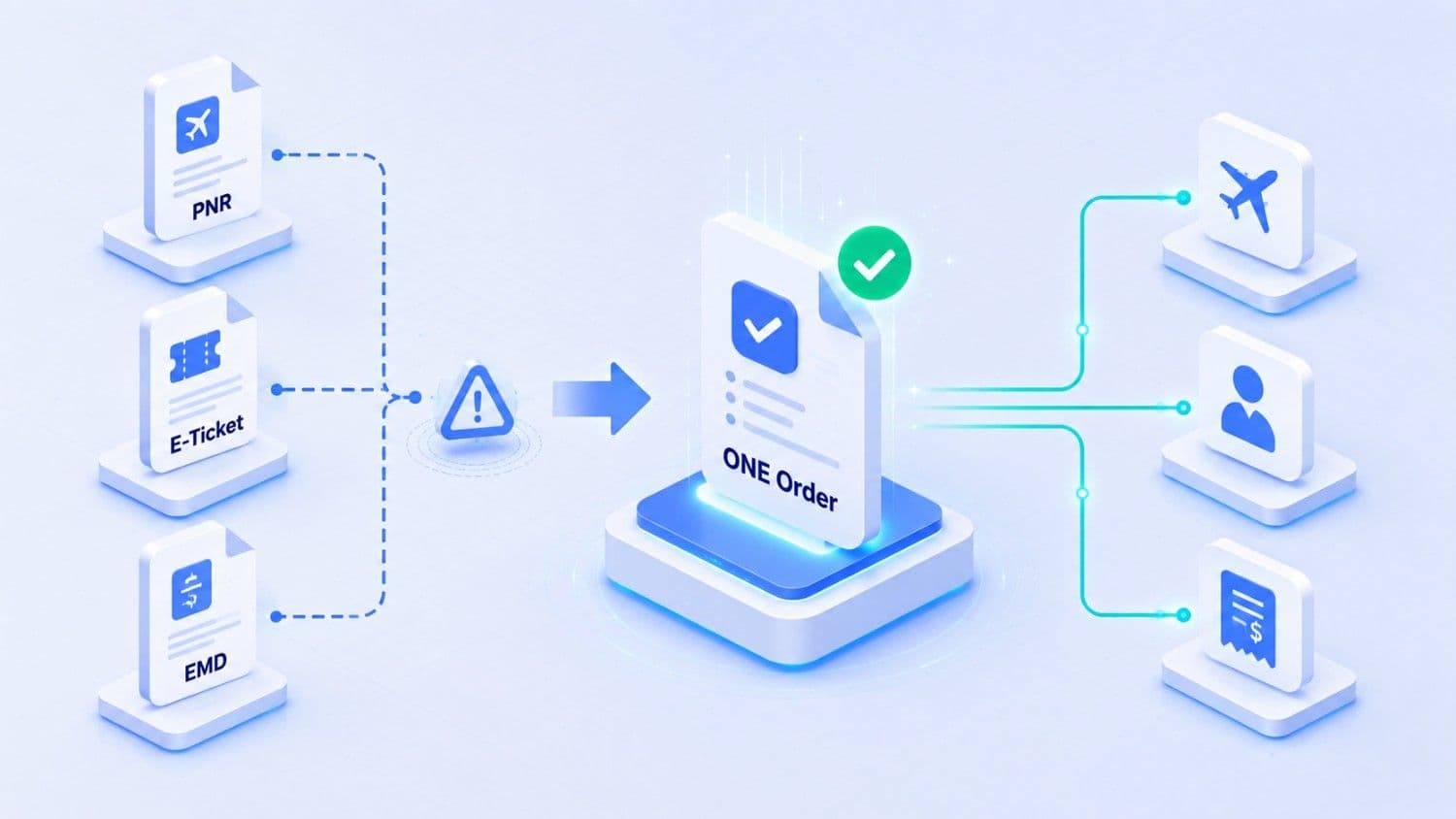
In May 2025, Finnair sold a flight entirely through IATA's ONE Order standard, no PNR, no separate e-ticket, no separate ancillary record, just one order from purchase to delivery. That single booking signals a shift travel businesses need to start preparing for now, even though full adoption is still years away.
In May 2025, Finnair sold a flight from Helsinki to London Heathrow on its own website and, in doing so, created what the airline called the world's first "Native Order," the first live production booking built entirely on IATA's ONE Order standard. No PNR. No separate e-ticket. No separate ancillary record. Just one order, from purchase through delivery. That single booking is the clearest signal yet that a standard IATA introduced back in 2016 is finally moving from concept to production, and travel businesses that wait until it is fully mainstream will be preparing years too late.
This guide explains what ONE Order actually is, how it differs from the booking records travel businesses work with today, where it stands in 2026, and what travel agencies, OTAs, and technology teams should actually be doing to prepare.
ONE Order is an industry-led standard developed by IATA that replaces the separate booking, ticketing, and ancillary records airlines currently use with a single, unified customer order. Instead of a Passenger Name Record for the itinerary, a separate e-ticket for payment proof, and a separate Electronic Miscellaneous Document for ancillaries, ONE Order consolidates all of that into one XML-based record that follows the booking from purchase through delivery and accounting.
IATA describes it as an initiative to modernize the order management process in the airline industry, replacing multiple and rigid booking, ticketing, delivery, and accounting methods with a single, flexible order built on the same data communication standards that power NDC.
Today, a single flight purchase can generate three separate records. The Passenger Name Record holds the itinerary and passenger details. The e-ticket serves as digital proof of payment, a requirement in the airline industry since 2008. The Electronic Miscellaneous Document tracks any ancillaries purchased separately, things like extra bags, seat selection, or onboard meals. Each record lives somewhat independently, which means airlines, travel agents, and ground handlers often have to reconcile data across three different documents just to understand one passenger's full booking.
ONE Order merges all three into one container: order number, passenger data, itinerary, payment status, ticketing information, and ancillary details, all in a single structure that functions more like a shopping basket than a paper-based ticketing chain. A traveler can add flights, seats, baggage, and even third-party products like hotel rooms under one reference number, and every party in the transaction, the airline, the travel agent, the ground handler, works from that same single source of truth.
Takeaway: the PNR model splits a booking into multiple disconnected records that have to be reconciled after the fact. ONE Order keeps everything in a single record from the start, which is the entire point.
ONE Order and NDC are frequently mentioned together because they solve two different halves of the same problem. NDC gives airlines the ability to create richer, more personalized offers, branded fares, bundled ancillaries, dynamic pricing, through modern APIs. But an airline's ability to actually deliver on those offers is limited if its back-end systems still rely on legacy PNR, e-ticket, and EMD records built for a much simpler product. ONE Order is what allows an airline to fulfill and account for everything NDC allows it to sell.
Put simply, NDC modernizes the offer. ONE Order modernizes the order. Without ONE Order, airlines can present sophisticated NDC offers to customers but still struggle to deliver, service, and reconcile them properly on the back end.
Progress has been real but slower than IATA's original ambitions. By mid-2025, only 27 percent of airlines had made meaningful progress toward the broader Offer and Order transformation, according to a joint Accelya and Atmosphere Research report. Currently, nearly 40 pilots and proof-of-concept projects are underway industry-wide, and a small number of airlines, including Lufthansa Group, Qatar Airways, and Emirates, have completed pilot programs testing ONE Order logic on select routes.
IATA's aspirational goal is full ONE Order capability by 2030, but more measured industry projections point to most airlines transitioning during the 2028 to 2029 window, with widespread adoption unlikely before 2030. That matches almost exactly the adoption curve the industry is already following for NDC and the broader Offers and Orders transition, which makes sense, since ONE Order depends directly on the same underlying data infrastructure.
This is the real reason adoption is taking years rather than months. The shift to ONE Order is projected to take three to seven years per carrier and require an investment of 50 to 100 million dollars, a heavy commitment given how thin airline margins already are. The industry as a whole was projected to earn a net profit of just 7.20 dollars per passenger in 2025, which leaves very little room for airlines to justify large up-front technology spending without a clear return.
The upside is significant enough that most major carriers are moving forward anyway. McKinsey research estimates that improved retailing techniques, ONE Order included, could unlock as much as 45 billion dollars in additional industry value by 2030, with some carriers potentially capturing 2 to 3 percent of annual revenue from better retailing and order management alone. For airlines with the balance sheet to make the investment, the math increasingly favors moving now rather than waiting for the technology to mature further.
Airlines have two practical paths to ONE Order capability. The first is migrating to a fully order-based Passenger Service System, replacing the legacy PSS entirely. Very few platforms currently support this natively: Navitaire New Skies for hybrid and low-cost carriers, Amadeus Nevio, TIK Systems PSS, and FLYR PSS, while Sabre is building order-enabled capability into its Mosaic platform. Amadeus Nevio is the technology behind Finnair's Native Order example, making it the most concretely proven order-based PSS in live production today, and it sits alongside the broader Amadeus GDS ecosystem many travel businesses already connect to for flight content.
The second path is layering a dedicated Order Management System on top of an airline's existing legacy PSS, handling order-based processes for selected products or channels without requiring a full system replacement. This is generally the lower-risk, faster path, and it explains why most of the nearly 40 active pilots are running this way rather than attempting a full PSS migration on day one.
ONE Order's effects reach well beyond airlines. Travel agents, global distribution systems, passenger service system suppliers, and airline e-commerce platforms are all directly affected, along with delivery providers like ground handlers, who benefit from complete, structured passenger and service data rather than reconciling three separate records. For travel agencies specifically, this eventually means adapting booking and servicing workflows away from PNR-based logic toward order-based logic, a shift that touches ticketing, refunds, reissues, and back-office reconciliation all at once.
A concrete proof point of what this can mean operationally comes from a 2020 interline pilot between British Airways and Vueling, which tested how NDC schemas could remove the complexity of managing separate PNRs, tickets, and EMDs between a traditional ticketed carrier and a ticketless one. The pilot successfully rebooked Vueling passengers onto British Airways in three clicks and under three minutes, a meaningful improvement over the multi-record reconciliation that disruption handling typically requires today.
It is worth being honest about the pace here. ONE Order cannot succeed in isolation. It depends on airlines, technology vendors, travel agencies, and GDSs all moving in sync, and with each participant following its own roadmap, full industry coordination is a genuinely difficult, multi-year undertaking, not a switch that flips on a single date. For a deeper look at how the major GDS platforms are positioning themselves through this broader retailing transition, our comparison of Amadeus, Sabre, and Travelport covers where each stands today.
Given the realistic 2028 to 2029 timeline for most airlines, preparation should be deliberate rather than urgent. A few practical steps make sense now.
Track which airlines you sell most are actually piloting ONE Order. Lufthansa Group, Qatar Airways, and Emirates are furthest along. If a meaningful share of your bookings run through these carriers, their transition timeline will affect your operations sooner than the industry average.
Understand your current PSS and GDS dependencies before ONE Order arrives. Agencies whose booking and back-office systems are deeply hardcoded around PNR-specific logic will face more rework than agencies already working with flexible, API-driven booking infrastructure.
Do not wait for a single cutover date. Because most airlines are expected to adopt an OMS-layer approach rather than a full PSS replacement, ONE Order will likely arrive gradually, airline by airline, product by product, rather than as an industry-wide switch. Building booking and servicing workflows that can handle both PNR-based and order-based bookings simultaneously will be the practical reality for years, not a temporary transition state.
ONE Order is an IATA-led standard that replaces the separate PNR, e-ticket, and EMD records currently used in airline bookings with a single, unified customer order record covering the full itinerary, payment, and ancillary information.
A PNR captures itinerary and passenger details but exists separately from ticketing and ancillary records. ONE Order consolidates all of this into a single order record, eliminating the need to reconcile data across three separate documents.
IATA's aspirational goal is 2030, but more measured industry projections point to most airlines transitioning in the 2028 to 2029 window, with the same pace roughly matching the broader NDC and Offers and Orders adoption timeline.
Finnair created the first live "Native Order" booking in May 2025 using Amadeus Nevio technology. Lufthansa Group, Qatar Airways, and Emirates have completed ONE Order pilot programs, and nearly 40 pilots are active industry-wide as of 2026.
The transition typically requires 50 to 100 million dollars per carrier and takes three to seven years, a significant investment given the airline industry's thin profit margins.
No. NDC and ONE Order address different parts of the same transition. NDC modernizes how airlines create and distribute offers. ONE Order modernizes how airlines deliver, service, and account for what was sold.
Travel agencies will eventually need to adapt booking and servicing workflows away from PNR-based logic toward order-based logic. Because adoption will roll out airline by airline over several years, agencies should expect to support both models simultaneously for an extended period.
ONE Order is not an abstract future standard anymore, Finnair's live Native Order booking in 2025 proved the technology works in production. What it is not, at least not yet, is a near-term industry-wide requirement. Most airlines are still years away from full adoption, and the realistic preparation window runs through 2028 and beyond. The travel businesses that come out ahead will be the ones that understand the shift now, track which of their airline partners are moving fastest, and build booking infrastructure flexible enough to handle both the old model and the new one at the same time, rather than the ones scrambling to react once a major carrier makes the switch.
If you want help assessing what your current booking infrastructure would need to support order-based workflows, you can hire a travel technology developer to review your specific setup.
Sources: IATA, Fulfilment with Orders: ONE Order; Amadeus Nevio; AltexSoft, "ONE Order by IATA: A Look at Progress and Roadblocks," June 2026.