
OneClick Travel Tech is a leading travel technology company specializing in custom travel booking solutions, offering services like B2B and B2C travel portal development, white label solutions and mobile app development to enhance customer experiences.
© ONECLICK TRAVEL TECH. ALL RIGHTS RESERVED.


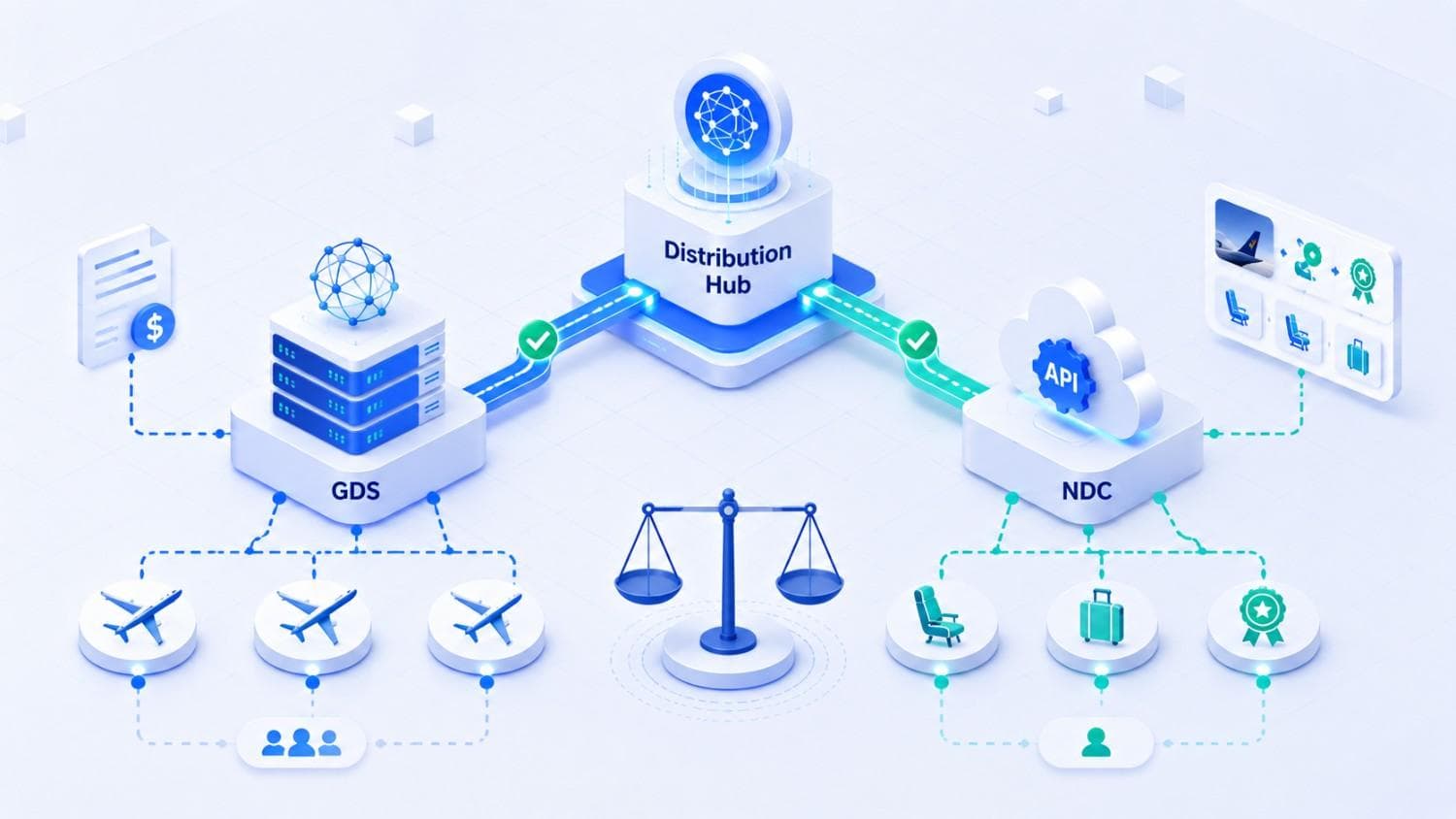
If you sell flights through a travel agency in 2026, you cannot avoid this question: should your bookings run through a GDS, connect directly to airline NDC APIs, or use both. Airlines are already pushing agencies toward NDC through rising GDS surcharges, and the choice is affecting margins right now.
If you sell flights through a travel agency in 2026, you cannot avoid this question anymore: should your bookings run through a GDS, connect directly to airline NDC APIs, or use both. Airlines are not waiting for agencies to decide. They are actively pushing the shift, and it is already showing up on invoices.
NDC bookings made up roughly 24 percent of indirect airline ticket sales globally in early 2026, up from just 11 percent in 2023. North American corporate NDC volumes grew 168 percent year over year in the same period. That is not a slow, theoretical trend. It is a fast, measurable shift in how airlines want to sell seats, and it directly affects how travel agencies need to build their booking technology this year.
This guide explains what GDS and NDC actually mean, where they genuinely differ, why airlines are charging more for traditional GDS bookings, and what a practical decision framework looks like for an agency deciding how to move forward.
Agentic AI refers to AI systems that complete multi-step tasks on a traveler's behalf, rather than simply answering questions or presenting options. In a booking context, this means an AI agent can search live inventory across airlines, weigh a traveler's preferences and loyalty status, apply payment, and confirm a reservation within a single conversation.
The distinction that matters here is autonomy. A standard travel chatbot retrieves information. An agentic system plans a sequence of actions, executes them, and only checks in with a human when a decision requires it. That is a fundamentally different piece of software, even if both are labeled "AI" in a vendor's marketing
A Global Distribution System, or GDS, is a centralized network that lets travel agents search, compare, book, and service flights from multiple airlines through a single connection. Amadeus, Sabre, and Travelport are the three dominant GDS platforms, together handling the large majority of indirect airline bookings worldwide.
Instead of connecting to every airline one at a time, an agency connects once to a GDS and gets access to standardized fares, schedules, and availability across hundreds of carriers. The GDS also handles the parts of the job that happen after the sale, ticketing, changes, refunds, and reissues, through workflows agents have relied on for decades.
New Distribution Capability, or NDC, is a data standard developed by IATA that lets airlines distribute richer, more flexible offers directly through APIs rather than filing static fares into a shared distribution network. Instead of a plain fare code, an NDC offer can include branded fare families, baggage allowances, seat selection, meals, and bundled products, all created and controlled directly by the airline.
The distinction is really about control. In the GDS model, airlines file fares into a standardized system that displays them the same way to every seller. In the NDC model, the airline builds the offer itself and decides exactly what to include and how to price it, closer to how an airline's own website sells a ticket than to a traditional agency display.
A GDS gives agencies broad, established airline coverage through one connection, along with mature ticketing, refund, and servicing workflows that most agency staff are already trained on. It remains the backbone of corporate travel programs and back-office systems that were built around GDS data formats. The tradeoff is limited flexibility, GDS fares are largely standardized and offer less room for airlines to differentiate branded products or personalize pricing.
NDC gives agencies access to richer, airline-controlled content, branded fares, dynamic pricing, and ancillaries that are often not fully visible through traditional GDS channels. It also typically carries a lower distribution surcharge than GDS bookings on the same airline. The tradeoff is inconsistency, NDC implementation varies significantly by airline, and servicing capabilities such as changes, refunds, and reissues are not always as mature as they are on GDS.
Takeaway: GDS wins on breadth and servicing maturity. NDC wins on content richness and cost per booking. Most agencies will need both, not one or the other.
This is the part travel agencies are feeling directly, not just reading about. Lufthansa Group raised its Distribution Cost Charge for GDS bookings effective January 1, 2026, with new per ticket rates of EUR 18.00 for Amadeus, EUR 22.50 for Sabre, and EUR 23.00 for Travelport, then raised the charge again in May. Lufthansa executives have said the charge is meant partly to cover the cost of traditional retailing and partly to move agencies toward its NDC Partner Program, which carries a significantly lower fee. It appears to be working. The airline group was on track to handle 75 percent of total bookings through NDC or direct channels as of last summer.
Traditional GDS fees generally run 3 to 15 dollars per segment, while NDC bookings made through a GDS typically carry a smaller surcharge, up to roughly 6 dollars per segment. For an agency booking a meaningful volume of tickets every month, that gap adds up fast, and it is the single clearest financial argument for building NDC capability rather than treating it as optional.
None of the major GDS providers are standing still. Sabre's NDC implementation runs on modern REST and JSON Offer and Order APIs, a web native approach many development teams prefer, supporting 22 ARM capabilities for sellers and 18 for airlines. Amadeus aggregates NDC content from participating airlines through its NDC-X program, which lets agencies using Amadeus GDS API integration access some NDC content without needing a separate connection to every airline individually. Travelport currently offers NDC-enabled retailing functionality only on the seller side, and has been notably aggressive on NDC content partnerships to stay competitive given it holds the smallest share of the big three GDS platforms.
For a fuller side by side view of how the three platforms differ beyond NDC specifically, our own comparison of Amadeus, Sabre, and Travelport breaks down regional strength, API quality, and pricing in more depth.
Two concerns come up constantly when agencies evaluate this shift, and both are legitimate.
Cost. Building full NDC integration from scratch, with complete certification against an airline's specific implementation, can run 15,000 to 25,000 dollars per integration. That is a real number, not a scare tactic, and it is the reason most agencies do not attempt direct NDC connections to every airline one by one. Agencies working with a platform that already has pre-built NDC connectors avoid that cost entirely, which is usually the more practical starting point. Our breakdown of GDS API pricing and access covers how these costs typically break down for agencies evaluating build versus buy decisions.
Reliability. NDC implementation is not consistent across airlines. One carrier may support full booking and servicing through NDC, while another supports search and booking but still requires a phone call for a refund. This inconsistency is one of the most common integration challenges agencies run into, and it is a genuine reason many agencies keep GDS as their primary servicing channel even as they add NDC content on top.
Neither of these concerns is a reason to avoid NDC. They are reasons to plan the transition deliberately rather than switching everything at once.
To see what a properly executed NDC integration looks like in practice, our Amadeus NDC integration built for Emirates is a useful reference point. The project connected NDC-specific content, including branded fares and ancillaries beyond what traditional GDS fare filing supports, directly into an existing Amadeus based booking workflow, without requiring a rebuild of the agency's entire distribution stack. That is the practical middle ground most agencies are actually looking for: adding NDC capability where it delivers real content and cost advantages, without discarding the GDS infrastructure that still handles the bulk of servicing.
Use GDS as your primary channel if: your agency handles significant corporate travel, complex multi-airline itineraries, or high servicing volume, changes, refunds, reissues, where GDS workflows remain the most mature and reliable option available today.
Add NDC where it delivers a clear return if: you sell heavily on specific airlines that have strong NDC programs, such as Lufthansa Group, American Airlines, or Emirates, where the content gap and surcharge savings are largest and most immediate.
Build for hybrid distribution from the start if: you are launching a new booking platform or upgrading an existing one. Aggregating GDS and airline inventory into a single distribution layer avoids the operational chaos of managing GDS, NDC, and direct airline connections as separate, disconnected systems, which is the single most common technical mistake agencies make when they try to bolt NDC onto an existing GDS-only setup after the fact.
For agencies still running mostly manual or GDS-only workflows, our custom Amadeus GDS solutions built for travel agents walk through what a practical, staged upgrade path looks like without requiring a full platform rebuild on day one.
A GDS is a centralized network, Amadeus, Sabre, and Travelport, that lets agencies search and book flights from many airlines through one standardized connection. NDC is an IATA data standard that lets airlines distribute richer, airline-controlled offers, including branded fares and ancillaries, directly through APIs.
Not immediately. IATA's own roadmap targets core Offers and Orders capabilities for leading airlines by 2026, expanded capabilities by 2028, and full industry readiness by 2030. Most agencies will operate in a hybrid model for years, using GDS and NDC content side by side.
Airlines, led by Lufthansa Group starting in 2015, add distribution cost charges to traditional GDS bookings to cover distribution costs and to push agencies toward lower-fee NDC and direct channels. Lufthansa raised its GDS surcharge again in January 2026 and once more in May.
According to IATA, roughly 77 airlines, about 20 percent of IATA members, currently provide NDC content, with the most mature programs run by Lufthansa Group, American Airlines, United Airlines, Qantas, Emirates, and Qatar Airways.
For most agencies, yes. GDS still provides the broadest airline coverage and the most mature servicing workflows, while NDC provides richer content and lower surcharges on the airlines that support it well. A hybrid approach captures the advantages of both.
Building a full NDC integration from scratch, including certification with a specific airline's implementation, typically costs 15,000 to 25,000 dollars per integration. Agencies using a platform with pre-built NDC connectors generally avoid this cost.
NDC is not a replacement for GDS in 2026, and it will not be for several more years based on IATA's own timeline. What has changed is the cost of ignoring it. Surcharges on traditional GDS bookings are rising, the content gap between NDC and GDS fares is real and growing, and agencies that treat this as a someday problem are going to feel it first on their margins. The practical move for most agencies is not choosing a side, it is building distribution infrastructure that can handle GDS, NDC, and direct airline content together, without turning every new supplier connection into a separate operational headache.
If you are evaluating what that would take for your own booking platform, you can hire a travel technology developer to scope the specific integration work involved.
Sources: IATA, New Distribution Capability Program; Travel Market Report, "Lufthansa Group Hikes GDS Booking Fee for Amadeus, Sabre, and Travelport"; PNRGenius, "Amadeus vs Sabre vs Travelport: Which GDS Should You Choose in 2026?"