
OneClick Travel Tech is a leading travel technology company specializing in custom travel booking solutions, offering services like B2B and B2C travel portal development, white label solutions and mobile app development to enhance customer experiences.
© ONECLICK TRAVEL TECH. ALL RIGHTS RESERVED.


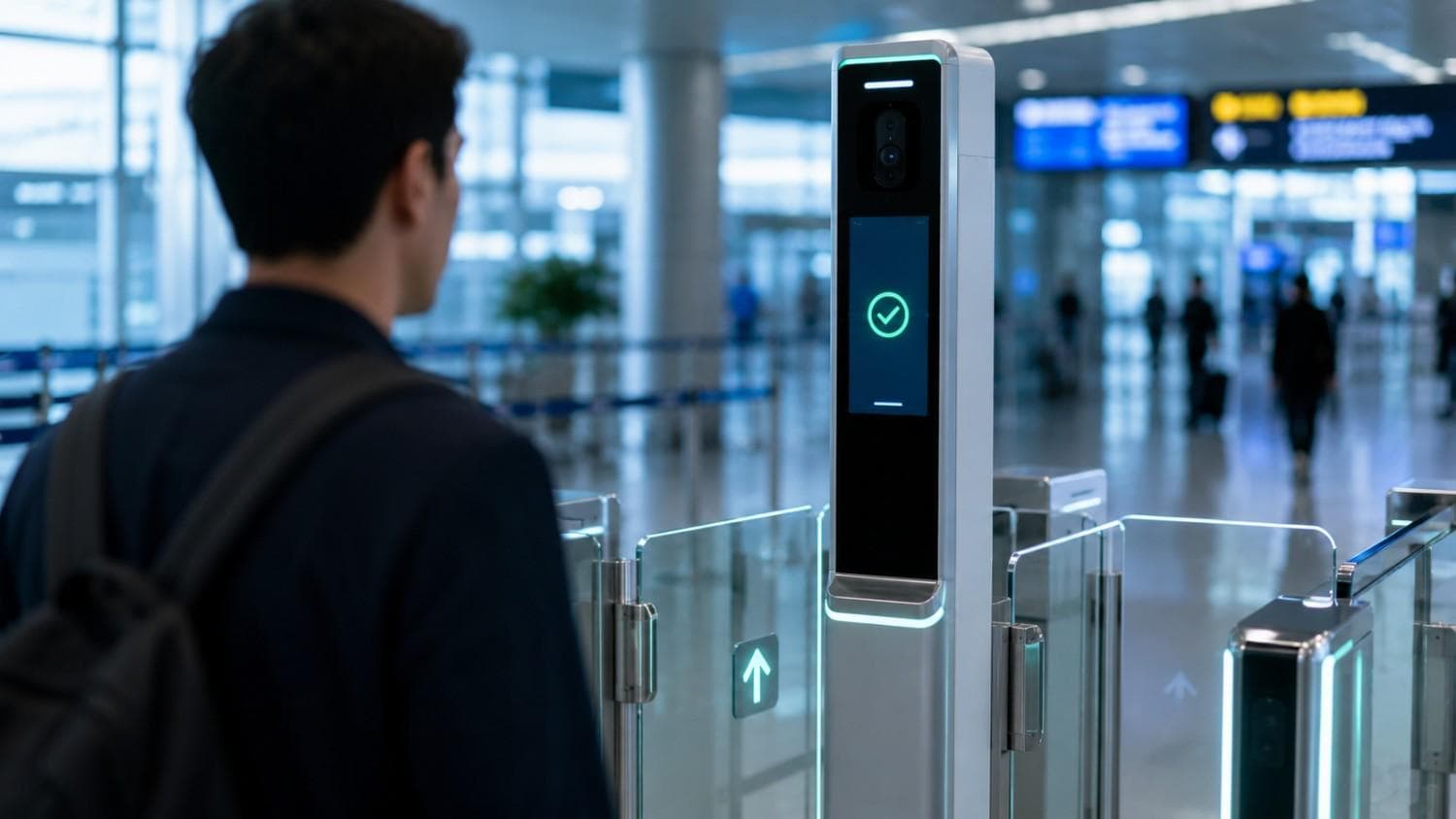
Europe's Entry/Exit System went fully live in April 2026, replacing passport stamps with facial scans at every Schengen border. TSA's Touchless ID is expanding to 65 US airports the same year. Facial recognition in travel has moved past pilots into real infrastructure, and here's how it actually works.
Europe's Entry/Exit System went fully live on April 10, 2026, replacing passport stamps with fingerprints and facial scans at every Schengen border. More than 45 million crossings have already been registered. In the US, TSA's Touchless ID program is expanding from 15 to 65 airports this spring, a 433 percent jump. Facial recognition in travel has moved past the pilot stage. It is now core infrastructure, and travel businesses need to understand how it works, not just that it exists.
This guide covers how airport facial recognition actually works, the two biggest 2026 rollouts driving adoption, what travelers can and cannot refuse, and how this connects to the broader identity and distribution shift covered elsewhere in this series.
The mechanism is consistent across most systems: a camera captures a traveler's face, an algorithm compares it against the photo stored in a biometric passport chip or a pre-enrolled digital credential, and the system confirms identity in a matter of seconds. That same verified credential is often what powers faster, more accurate booking too, the kind of underlying traveler data AI travel agents rely on to complete a booking without manual re-entry. This is verification, comparing a face against one specific document, not identification, searching for a face across a database of millions. That distinction matters for the privacy conversation, since verification is a narrower, lower-risk process than mass identification.
Modern systems increasingly combine multiple signals, face plus iris, infrared sensors for reliable performance in different lighting, and liveness detection designed to catch spoofing attempts using photos, masks, or deepfakes.
The European Union's Entry/Exit System became fully operational across all Schengen external borders on April 10, 2026, replacing manual passport stamping with digitally recorded entries and exits for non-EU travelers, capturing fingerprints and a facial image at first arrival. Since the phased rollout began in October 2025, more than 45 million border crossings have been registered, with over 24,000 people refused entry for reasons including expired documents or insufficient justification for their visit.
The launch has not been seamless. Border queues have reportedly hit two to five hours at peak times at some crossings, with congestion reported at major airports including Milan, and some countries temporarily pausing EES at specific locations while the European Commission has held firm on not delaying the overall rollout schedule despite industry pressure. This is a genuinely useful, honest detail for travel businesses to understand: EES is real, mandatory infrastructure now, but its early operational performance has been uneven, and that friction is directly relevant to any business managing traveler expectations around European arrivals in 2026.
In the US, TSA PreCheck Touchless ID is expanding from 15 to 65 airports by spring 2026, letting eligible travelers clear security with a facial scan instead of presenting a physical ID or boarding pass. American Airlines launched the program at four airports in May 2025, and participating carriers now include American, Alaska, Delta, Southwest, and United.
Separately, TSA and CLEAR are piloting biometric eGates at three major airports, Atlanta, Reagan National, and Seattle-Tacoma, ahead of the anticipated surge in international arrivals tied to the 2026 FIFA World Cup. CLEAR Plus members can verify identity at a facial recognition-enabled gate and bypass the traditional document-check podium entirely, with TSA retaining full vetting authority over the automated process. This kind of infrastructure investment mirrors the same broader push toward Modern Airline Retailing covered in our ONE Order piece, airlines and airports modernizing legacy processes in parallel, not in isolation.
This is the question that matters most to travelers, and the honest answer depends on where you are and who you are.
In the United States, TSA's own guidance states that participation in facial recognition at checkpoints is voluntary, and travelers can decline the photo step and request alternative identity verification. TSA says images captured during standard checkpoint verification are deleted immediately after the check, and CBP has stated that photographs of US citizens taken during its biometric travel process are discarded within 12 hours of a successful match, though the underlying travel record remains in standard government files. Foreign nationals generally do not have the same right to refuse during CBP entry processing.
In the EU, refusing facial recognition at a standard airport checkpoint is a protected right, and an airport must offer a non-biometric alternative lane. The exception is the EES itself: for non-EU nationals crossing a Schengen external border, biometric registration is mandatory, with no opt-out available.
This is the part of the story that gets underplayed in a lot of coverage. TSA's facial recognition expansion has drawn genuine, organized opposition, several US senators have called for a halt to the program, a bipartisan Traveler Privacy Protection Act was introduced in 2024, and the DHS Inspector General opened a formal investigation into TSA's facial recognition practices in early 2025. This isn't fringe criticism, it's active legislative and oversight scrutiny running in parallel with the technology's rapid rollout.
For travel businesses, the practical takeaway is that biometric infrastructure is not a settled, uncontroversial convenience feature. It's infrastructure that a meaningful share of the traveling public, and a meaningful share of lawmakers, are actively still negotiating the terms of. Building products or messaging that assume universal, uncomplicated acceptance is a real risk.
Facial recognition doesn't exist as a standalone feature, it's the verification layer sitting underneath a broader identity infrastructure shift. IATA's One ID initiative, the standard behind most of the pilots referenced throughout this post, rests on two pillars: digitizing admissibility checks like visas before departure, and enabling contactless biometric travel through the airport itself. Identity, order management, and biometric verification are converging into a single connected infrastructure shift, not three unrelated trends.
Given how fast this is moving, and how unevenly it's rolling out, a few practical steps are worth prioritizing now.
Understand which of your travelers' destinations are affected by EES specifically. If your customer base includes meaningful non-EU travel into Schengen countries, the mandatory biometric registration and its current operational friction are directly relevant to setting accurate expectations, particularly around arrival timing during peak season.
Track airline-side Touchless ID participation, not just TSA's airport count. The 65-airport expansion only matters to a traveler if their airline also participates, and that list is narrower than the airport list. Knowing which carriers your customers actually fly matters more than the headline expansion number.
Don't treat biometric adoption as fully resolved or uncontroversial. With active legislative pushback and a formal federal investigation underway in the US, and a genuinely bumpy EES rollout in Europe, this is still a live, evolving story, not a finished implementation. Messaging and product decisions built on the assumption that this is a settled, universally welcomed shift are likely to age poorly.
As identity, order management, and biometric verification continue converging, airlines and travel platforms building AI-driven travel solutions will increasingly need all three working together rather than as separate, disconnected systems.
TSA Touchless ID is a voluntary program letting eligible TSA PreCheck travelers use a facial scan instead of a physical ID or boarding pass at security. It's expanding from 15 to 65 US airports by spring 2026, with participation from airlines including American, Alaska, Delta, Southwest, and United.
The technology itself has strong accuracy in controlled conditions, but "safe" also depends on data handling. Policies vary significantly by country and program, US retention periods differ for citizens versus foreign nationals, and the technology remains under active legislative and oversight scrutiny in the US.
In the EU, yes, at standard checkpoints, and an alternative must be offered. The exception is the mandatory EES biometric registration for non-EU nationals entering the Schengen area. In the US, TSA's checkpoint process is stated to be voluntary for citizens, though foreign nationals generally cannot refuse CBP's biometric entry process.
The EES is the EU's digital border control system, fully operational since April 10, 2026, which replaces passport stamps with fingerprint and facial scan registration for non-EU travelers entering or leaving the Schengen area, tracking their permitted 90-day stay window automatically.
A camera captures a traveler's face and compares it against a pre-verified credential, either a biometric passport chip or a stored digital identity wallet credential, confirming identity in seconds without requiring a physical document to be shown at each checkpoint.
It depends on the program and the traveler's status. Standard airport checkpoint biometrics are generally voluntary with an alternative available. Border-crossing systems like the EU's EES are mandatory for non-EU nationals, with no opt-out.
Facial recognition in travel crossed a real threshold in 2026, not because the technology changed, but because two major, mandatory-adjacent systems, the EU's EES and TSA's rapid Touchless ID expansion, went live at scale within months of each other. The adoption numbers are genuinely strong, but so is the pushback, active legislation, a federal investigation, and a rocky EES rollout are all happening in parallel with the expansion, not after it. Travel businesses that treat this as settled, uncomplicated infrastructure are missing half the story, and the half they're missing is exactly the part their customers are most likely to ask about.
If you're building booking or verification infrastructure that needs to account for biometric and digital identity requirements, you can hire a travel technology developer to review what that means for your specific platform.
Sources: IATA, One ID Program; IATA, PoCs Prove Industry Is Ready for Contactless Travel; US Customs and Border Protection, Biometrics.